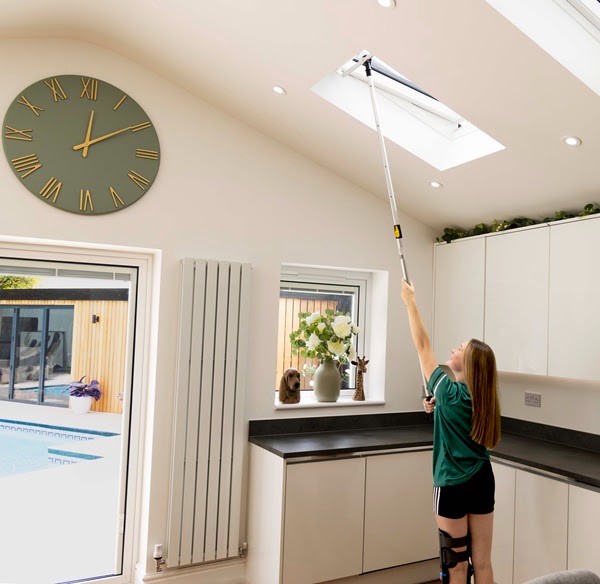
MGS Brings Innovative Engineering to WinHux Hook Technology
Transitioning from a stable 20-year clinical career to high-value product design requires confidence and strong supporting partners. By combining Damian Pendlebury’s innovative product vision with MGS Technical Group’s expertise in toolmaking and injection moulding, the two North West businesses have successfully scaled up a side hustle to 40,000 in annual sales. In 2017, frustrated by the sales-driven nature of optometry, Damian Pendlebury taught himself CAD to design a superior extension pole hook that outperformed existing market alternatives in both durability and versatility. After initial production struggles with consistency, the business transitioned to Lancashire-based MGS Technical Group.
This engineering alignment has enabled the telescopic pole hooks to withstand significant loads and meet demanding durability requirements, supporting Damian’s five-year quality guarantee and positioning WinHux as a market leader in its category. Currently sold exclusively on Amazon, the company is on target to reach 40,000 sales annually. With the support of MGS, Damian plans to expand into wholesale DIY channels while maintaining a commitment to high-quality, locally manufactured components.
Making it as a market disruptor :Seeking an exit strategy from optometry, Damian readily admits his Eureka moment was more a slow burn. “It started with a customised ophthalmoscope battery. That was a bit too niche as a product and certainly wasn’t going to set me up for retirement. But it made me realise that I wanted to design a product. I then observed a relative successfully selling products on Amazon.” Analysing the ‘skylight window pole’ category through the sales channel, Damian identified a high-volume market plagued by significant friction. “Established products were generating substantial sales despite poor customer reviews regarding durability and ease of use,” recalls Damian. He designed a hook and within six months he left optometry entirely. Launching a product is one thing. Scaling up to mass production is another strategy entirely,” notes Damian.
While many startups default to offshoring to keep overheads low, Damian viewed local manufacturing as a strategic asset for protecting intellectual property (IP) and maintaining technical agility. “The 40 minute proximity to MGS was not only a logistical convenience, it also became integral to our risk-mitigation strategy,” notes Damian. As soon as MGS was appointed the Lancashire-based Group immediately addressed several critical manufacturing hurdles.
Satisfaction over sales :Unlike competitors who use recycled regrind or inferior plastics to reduce costs, the team selected a virgin 30% glass-filled nylon 6 for the WinHux hook. “This material selection was key to quality as the molecular chains don’t degrade in regular use. While a standard window requires only 20kg of force to operate, the WinHux hook is engineered to support over 150kg,” explains MGS Business Development Manager Chloe Maine. Damian was adamant that long-term customer satisfaction was more important that repeat sales caused by breakages. The level of over-engineering ensures that the tactile experience and structural integrity of the WinHux hook matches its technical specifications. “The non slip surface combined with the universal ACME thread justifies its position as a premium disruptor in this household category,” emphasises Damian. MGS aligned to the ethos immediately. “In markets where consumers are accustomed to disappointment, providing a product made in the UK that lasts decades becomes a powerful differentiator,” agrees Chloe.
Local to local manufacturing :With the exception of the extendable window poles, the decision to keep production local was a calculated move by Damian to mitigate two primary risks – intellectual property theft and technical stagnation. Local production ensures that the design ‘know-how’ is retained within a secure and more regulated environment. This was vital given the hook’s deceptively complex design, which involves intricate threaded sections and requires repeatable precision moulding. By keeping the manufacturing of components and packaging within the UK, WinHux achieved end-to-end control over the final assembly. This eliminated the logistical uncertainty of offshore shipping and means that Damian has complete oversight over quality.
 “The technical agility of the MGS team cannot be downplayed. In person meetings enabled us to instantly resolve any tool design and manufacturing challenges. When components are technical, proximity is often more cost effective and faster than dealing with manufacturers operating in different time zones,” states the WinHux founder. This distinction became apparent after WinHux’s initial moulding attempts resulted in structural weaknesses and inconsistent results. MGS provided the technical synergy necessary to stabilise production, specifically through the management of a 1+1 cavity tool. This tooling configuration is a strategic choice for consistency, as it allows the hook and its corresponding component to be produced simultaneously in the same cycle, ensuring identical thermal history and material properties for both parts of the assembly. MGS services the production tools in-house more frequently than the industry norm. This rigour ensures that the precision of the 40,000th part is identical to the first.
Damian observes that MGS immediately demonstrated a mutual level of commitment to the long-term durability and success of both the production tool and the final part. “Their shared investment in the project’s future reflects their dedication to achieving the highest standards of quality and reliability throughout every stage of development.” Chloe highlights that the success of WinHux serves as a compelling demonstration of the lasting benefits of investing in high-quality, locally produced components. “Innovators like Damian underscores the potential for even modest enterprises to effect meaningful change through a commitment to excellence in manufacturing and a localised supply chain.”
MGS Technical Group offers a full end-to-end service and has dedicated teams that support innovators and OEMs through each stage of concept to commercialisation. “Manufacturing any component is a multi-stage process where success depends on matching specific, often highly technical skills to each phase. Every stage of the journey is different and in-house support for each element is an enabling factor to reduce risk and get products to market faster,” emphasises Chloe.
#MGS #injection moulding #WinHux #Amazon
#modernplasticsnetwork #printmagazine #printpublication#modernplasticsglobal #plasticnews